Your Cart is Empty


The van is a colorful symbol of American pioneering and exploration — more so than trucks ever were. Since the 1960s, the van has been an iconic symbol of peace, love, and the open road, but there is far more to its legacy than that. It is the original adventure vehicle. Long before overlanding had a name, before roof tents had a price tag, and before anyone called their weekend trip a "build," the van was already out there — loaded up, pointed west, and deep into terrain that most modern rigs only see in photos. It didn't need accessories to earn that title. It earned it by actually going.
It hauled climbers to the base of El Capitan in Yosemite. It rolled into Woodstock loaded with Deadheads, peace signs, and enough tie-dye to cover a football field. It carried surfboards down the Baja Peninsula, ski gear to Tahoe, and every road-tripping dreamer who ever had a map and a tank of gas.
The van was built for stacking. Built for packing. Built for loading up every last inch with gear, people, and whatever the journey demanded. It was — and still is — perfect for that life.
Peace. Love. Rainbows. And a bumper sticker for every national park.
But somewhere along the way, truck owners started borrowing that philosophy. And that's where things went sideways.
The van and the truck share a parking lot but not a purpose.
A van says yes to everything. More people, more gear, more weight — the platform is designed around it. The suspension expects it. The drivetrain is calibrated for it.
A truck is a different animal entirely. It's built around capability — towing, hauling, off-road performance, and access. It's engineered to get you somewhere a van could never go and to perform under conditions that would leave a minivan stranded on the shoulder.
The argument for adding accessories to a truck is valid. Nobody is questioning that. The problem is which accessories and how many — because we are not packing our trucks with pot-smoking hippies headed to a music festival. We are heading to trailheads. We are accessing remote terrain. We are running rocky descents, river crossings, and fire roads that punish every extra pound.
That context changes everything.
The overlanding boom brought with it a wave of add-ons that looked great on social media and performed terribly on the trail.
Roof racks loaded with gear shifted the center of gravity and turned stable platforms into tippy liabilities. Roof top tents — with an average lifespan of just four years — added hundreds of pounds of permanent weight and thousands in extra fuel costs over their lifetime. Bike racks hanging off the back stuck out into traffic, blocked backup cameras, got sideswiped in parking lots, stolen from driveways, and vandalized at trailheads. Side steps and running boards that nobody asked for started collecting mud and adding drag. Light bars that never got used in the dark started collecting dust and catching wind.
Every single one of these add-ons came with a hidden tax:
Extra weight means extra fuel at every fill-up. Overloaded suspension means accelerated wear on components that aren't cheap to replace. Rear-mounted bike racks mean your camera is blocked, your plate is obscured, and your bike is one bad driver away from a highway exit ramp. Roof-mounted gear means your truck now handles like a fully loaded van — except it wasn't built for that, and the physics don't care what you paid for it.
We borrowed the van's stacking philosophy and applied it to a platform that was never designed to reward it.
Be honest.
If your truck looks like it's ready for Woodstock — layers of gear, accessories stacked on accessories, every surface claimed — you might be driving a very expensive minivan with a lift kit.
There's nothing wrong with a van. Vans are incredible. But if you bought a truck to go places a van can't go, and then you loaded it up like one — you've undermined the entire reason you bought it.
The best off-road builds aren't the most loaded. They're the most intentional. Clean platforms that perform exactly as engineered, with gear that earns its place and nothing that doesn't.
No drilling. No permanent hardware. No roof rack. No swinging bike rack hanging into traffic with your $4,000 mountain bike as the crumple zone.
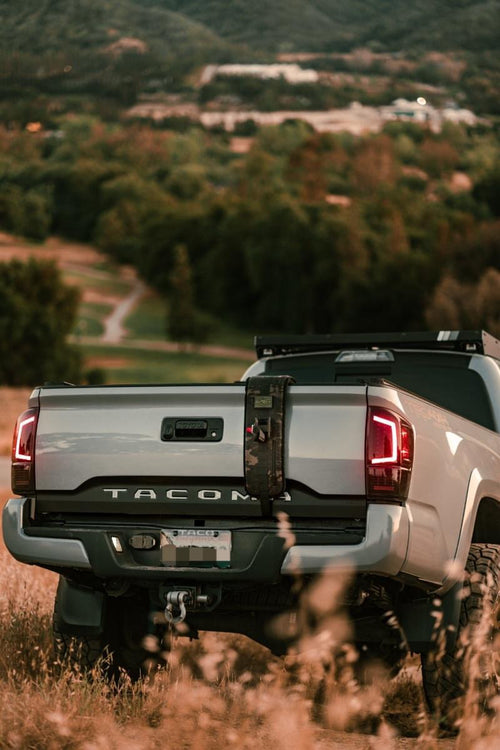
Bomber Strap is the minimalist, tactical alternative for truck owners who actually use their trucks.
Load your bike inside the bed. Secure it with a strap system that takes seconds, leaves zero marks, and disappears completely when you don't need it. Your backup camera stays clear. Your suspension carries only what it needs to. Your fuel economy doesn't take a hit every time you leave the driveway.
Your truck stays a truck.
Fast. Capable. Ready for the trail — not the festival.