Your Cart is Empty

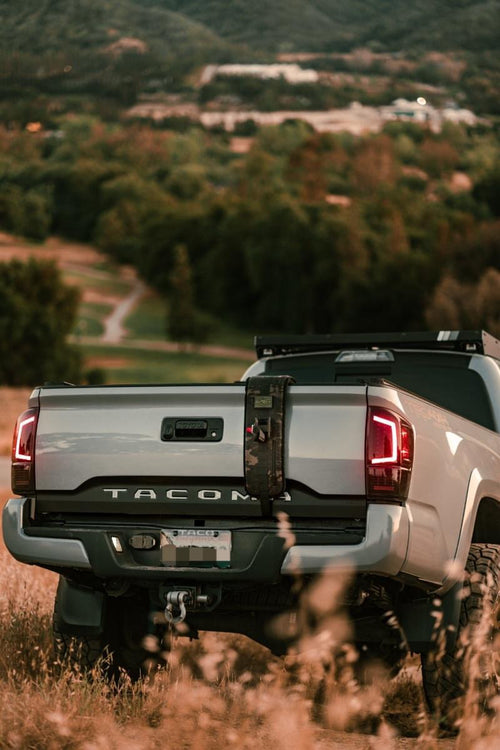

Meta Description: Over-accessorizing your truck is quietly destroying its performance, usability, and resale value. Here's why the mountain bike and e-bike community is ditching roof racks, hitch racks, and tailgate pads — and hauling smarter with Bomber Strap.
Not maliciously. Just profitably.
For the last decade, the overlanding and truck accessory market has sold you a single idea dressed up in a thousand different SKUs: more is better. More gear. More mounts. More racks. More bolted-on, drilled-in, strapped-down hardware that makes your truck look like it's ready for an expedition it will never actually take.
And it worked. The industry exploded. Roof rack manufacturers, hitch rack brands, tailgate pad companies, and bed rack builders have collectively pulled billions of dollars out of truck owners who genuinely believed they were upgrading their vehicles.
They weren't. They were degrading them.
Let's be brutally honest about what happens when you stack your truck with gear it wasn't designed to carry.
Your suspension suffers immediately and compounds over time. Factory suspension is tuned to a specific load profile. Every pound you add above that spec — roof tent, bed rack, overhead carrier, auxiliary tank — shifts your center of gravity, increases body roll, and accelerates wear on shocks, springs, and bushings that cost thousands to replace. The truck industry doesn't advertise this because it's bad for sales. Your suspension shop, however, will tell you exactly what's happening when you bring it in for early wear at 40,000 miles.
Your fuel economy takes a permanent hit. A roof rack alone at highway speed creates enough aerodynamic drag to reduce fuel efficiency by 10 to 25 percent. Not on trail days. Every single day you drive it — commuting, errands, highway miles — you are paying a fuel tax on gear that might come off the roof four times a year. Multiply that across 12 months of fill-ups and your "investment" in that rack system is costing you at the pump indefinitely.
Your usability collapses under the weight of your own build. The hitch rack that blocks your backup camera. The bed rack that turned your truck bed into an obstacle course. The roof tent you deployed twice but haul everywhere because you spent too much to leave it at home. The side steps that snap in cold weather and collect mud the rest of the time. The light bar that buzzes at 65mph and has never pointed at anything dark.
Every single one of these add-ons was supposed to make your truck more useful. Instead they made it more complicated, more expensive to run, harder to park, and significantly less capable of doing the one thing a truck does better than any other vehicle — going places and carrying things simply and effectively.
That's not a build. That's clutter with a lift kit and a payment plan.
Here's the one that really makes accessory brands nervous.
If you are hauling a 30 to 45 pound mountain bike on a roof rack, nursing a sore back after three hours on a technical climb, spending more time on drivetrain maintenance than actual riding, and dreading the climb back to the trailhead — the e-bike conversation is overdue.
An e-bike does not eliminate the ride. It extends it. Same trails. Same terrain. Same views and same culture — with a pedal assist system that lets you ride longer, go further, recover faster, and come back the next day instead of hobbling to the truck and sleeping for 14 hours.
The e-bike market is growing faster than any segment of the cycling industry because riders are figuring this out in real time. And the truck accessory industry hates it — because an e-bike rider who hauls their bike in the bed with a Bomber Strap doesn't need a roof rack, a hitch rack, a tailgate pad, a fork mount, a locking cable, or any of the $400 to $1,200 in hardware that goes with them.
They need one strap system. And they're done.
The truck bed is a flat, stable, enclosed platform with factory-engineered tie-down points designed to secure loads under real road conditions. It protects your bike from wind, weather, road debris, and the eyes of anyone walking through a parking lot looking for an easy score.
It keeps your backup camera clear. It keeps your license plate visible. It keeps your bike at a height where you can actually check it at a rest stop without a step ladder. It doesn't add drag, doesn't raise your center of gravity, and doesn't compromise your suspension with weight it wasn't designed to carry.
The only reason riders avoided the bed was the lack of a reliable, damage-free securing system. Old-school tie-downs scratch frames. Bungee cords shift and fail. Purpose-built bed racks solve one problem and create three more — cost, complexity, and permanence.
No drilling. No permanent hardware. No scratched frames. No monthly fuel tax. No blocked camera. No theft billboard hanging off your tailgate.
Bomber Strap secures your mountain bike or e-bike upright in the truck bed in under sixty seconds using the tie-down points your truck already has. It works on hardtails, full suspension, and e-bikes. It leaves zero marks on your frame. It rolls up and disappears into your gear bag when you're done.
One product. Solves the problem completely. Costs less than a single month of extra fuel from a roof rack.
The accessory industry built a $2 billion market telling you that hauling a bike required hundreds of dollars in hardware permanently mounted to the outside of your vehicle. Bomber Strap proved that was never true.
Your truck was built to go places. Keep it that way.