Your Cart is Empty


That pad you just bought? The one with the slick branding, the influencer cosign, and the $80–$120 price tag? Pull back the liner and take a look at what's actually inside.
Odds are, it's the same foam used to ship your last Amazon package.
The MTB tailgate pad market has a dirty little secret: the majority of pads on the market are filled with Polyethylene foam — a cheap, commodity packaging material — dressed up in a flashy shell and sold as performance protection gear. It isn't. It never was. And the moment you understand the difference between PE foam and EVA foam, you'll never look at a competitor's pad the same way again.
Walk into any warehouse. Look at the white foam wrapped around your electronics, your furniture, your appliances. That's Polyethylene foam. It's abundant, it's cheap to manufacture, and it gets the job done for one thing: protecting products during a single shipment.
It was never designed for repeated compression. It was never designed for outdoor exposure. It was never designed to absorb road vibration across hundreds of miles of highway and trail access roads.
But it's light, it's cheap, and it fills space — which is exactly why the tailgate pad industry reached for it and called it a day.
| Polyethylene Foam (PE) | EVA Foam | |
|---|---|---|
| Full Name | Polyethylene Foam | Ethylene-Vinyl Acetate Foam |
| Shore Value | 15–25 Shore C | 25–55 Shore C (tunable by density) |
| Pack Out Rate | High — permanent deformation after repeated compression cycles | Low — returns to original shape; engineered for repeated impact |
| Weather Resistance | Poor — open-cell versions absorb moisture; degrades with UV exposure | Excellent — closed-cell structure repels water; UV stable |
| Vibration Resistance | Poor — transmits vibration rather than absorbing it | Excellent — engineered specifically for vibration and impact dampening |
| Primary Industry Use | Packaging, single-use shipping protection | Footwear midsoles, marine equipment, sports helmets, premium protective gear |
| Lifespan Under Use | 1 season before noticeable compression loss | Multi-year with consistent performance retention |
| Cost to Manufacture | Very low | Moderate — reflects material quality |
Shore hardness measures a foam's resistance to permanent deformation under pressure. The higher and more consistent the Shore value, the better the foam holds its structure under load.
PE foam sits at the low end — soft enough to dent easily and stay dented. EVA foam is specifically engineered with a Shore value that balances impact absorption with structural recovery. It compresses when it needs to and comes back. PE compresses and stays there.
After one season of regular trail use — loading, unloading, highway miles, washboard roads — a PE foam core has packed out enough that your bike is effectively resting on a thin shell. You'd never know because the liner still looks fine from the outside.
That's the con. The exterior hides the failure.
Protecting your bike and your truck isn't complicated — but it does require getting three things right:
1. The right foam. EVA absorbs impact and recovers. PE absorbs impact and quits. There is no argument here — this is material science, not opinion.
2. Bike retention. A pad that just sits between your bike and the tailgate isn't enough. You need a system that actively holds the bike — down tube contact, fork retention, and a third point of contact — so the bike isn't free to move, bounce, or shift at speed. A bike that moves damages itself and your truck.
3. Functionality that respects your vehicle. Your backup camera exists for a reason. Your hitch receiver has jobs to do. A pad that blocks either one isn't a solution — it's a compromise you're paying for.
The Bomber Strap uses an EVA foam core paired with fleece-backed neoprene — two materials chosen because they do different jobs exceptionally well. The EVA handles the high-impact loads. The neoprene absorbs the micro-vibrations that EVA passes through. It's a two-stage damping system built the same way premium footwear and protective sports equipment is built.
No cheap liner over packaging foam. No blocked camera. No occupied hitch. No giant mat that looks ridiculous on a truck built to look sharp.
Just a pad that was designed by someone who actually mountain bikes, actually loads bikes onto trucks, and actually cares whether your bike and your paint make it home the same way they left.
Next time you're evaluating a tailgate pad — any pad — ask one question: what foam is in the core?
If they can't tell you, or if the answer is polyethylene, you know exactly what you're buying. A rebranded shipping insert with a logo on it.
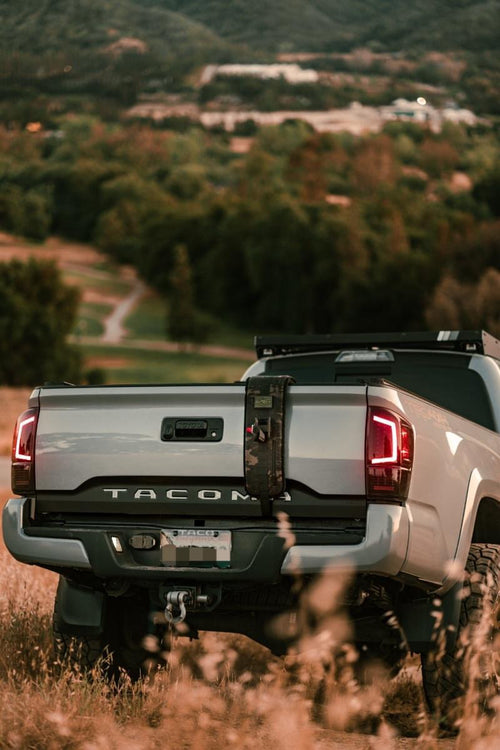
You deserve better. Your Tacoma definitely does.
The Bomber Strap — EVA core, neoprene dampening, patented 3-point retention system. Built by riders. Built to last.
We get it. Bold claims deserve proof. That's why we're not asking you to just trust us.
Watch the full independent review and see the Bomber Strap in action — foam, fit, retention system, and all.
Watch the Full Bomber Strap Review on YouTube
See exactly what separates real engineering from rebranded packaging foam — and why riders who've tried both aren't going back.