Your Cart is Empty

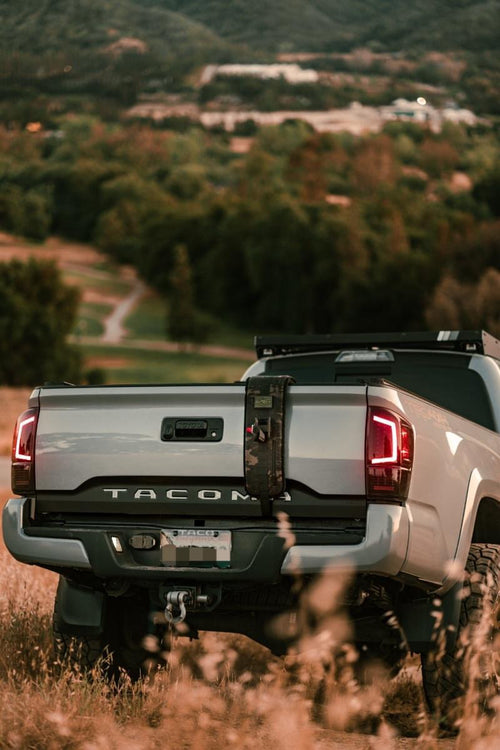

Most mountain bikers have a loading ritual that involves at least one of the following: a moving blanket thrown over the tailgate, a bungee cord that never quite reaches, a suspiciously optimistic amount of faith in friction, and at least one scratch they don't like to talk about.
There are two real solutions: a tailgate pad or a bike strap system. Both get your bike on the truck. Only one of them does it without drama. Here's the honest breakdown — so you can stop improvising and start riding.
What Is a Tailgate Pad?
A tailgate pad mounts over your lowered tailgate. You hook the front fork over the pad, the rear wheel drops into the bed, and you drive. The foam cushions the contact point between your downtube and your gate. Most pads hold four to six bikes alternating fork direction so handlebars don't tangle.
The setup is fast. Drop the gate, clip the straps, load your bikes. No tools. No assembly. No arguing in the parking lot. For groups shuttling bikes to a trail, a tailgate pad is the fastest system on the market — period.
The trade-off: bikes sit exposed to wind and road debris the whole drive. On a lifted truck, load height goes up with your suspension. And if you're hauling camping gear or an overland kit, bikes hanging off the back can limit bed access mid-trip.
What Is a Bike Strap System?
A bike strap system — like the Bomber Strap — locks your bike directly to the tailgate. Fork controlled. Bars locked from rotating. Frame protected at every contact point. The whole setup stays put even on rough forest service roads.
The difference is precision. A tailgate pad holds bikes in a general position. A strap system holds your specific bike in a specific position — controlled, stable, and locked. Your backup camera stays clear. Your hitch stays open. At the trailhead, you unclip in under a minute and your bike is on the ground.
Head-to-Head: Where Each One Wins
Speed: Groups of five or six — pad wins. Solo or two bikes — strap system matches or beats it in under two minutes.
Protection: Both protect paint. But a strap system locks the fork, prevents bar rotation, and kills the lateral movement that causes frame-on-frame contact on a group pad.
Bed and Hitch Access: Pad requires gate down the whole drive. Strap system keeps your hitch open and camera clear — critical if you're towing or overlanding.
Lifted Trucks: Loading onto a pad at 3–6 inches of lift is a workout solo. A strap system gives you a controlled placement instead of swinging a full-suspension bike and hoping it lands in the slot.
Rough Roads: On washboard, a pad shifts as foam compresses. A locked strap system doesn't move — fork fixed, bars fixed, bike exactly where you left it.
Which One Should You Buy?
Shuttle crew of four or more — get the pad. Speed wins.
Solo rider or one to two bikes — get the strap system. More control, less compromise, no drama.
The bungee cord era is over. Pick the one that matches how you actually ride.